
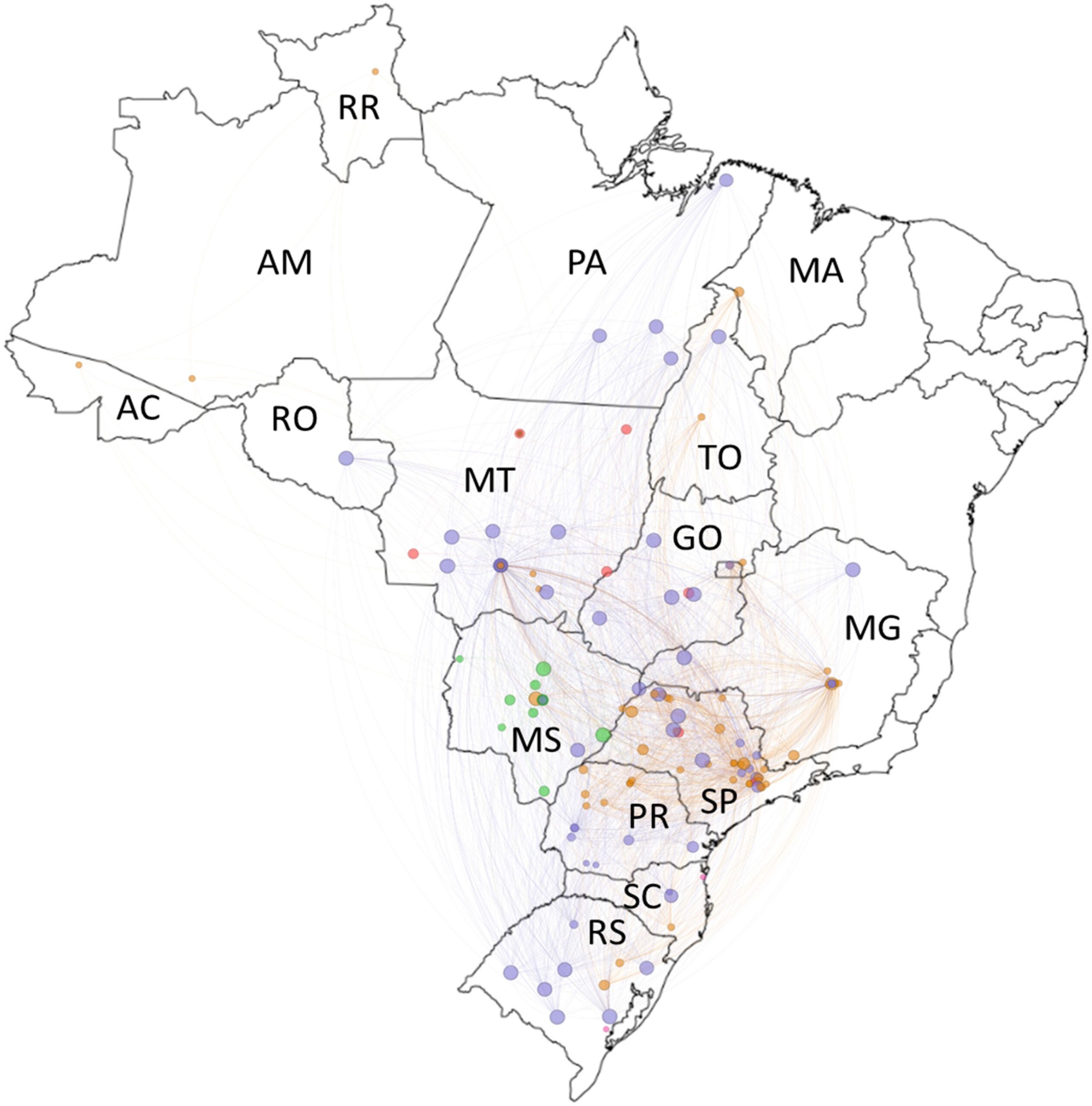
A non-directed network of meatpacking plants designed based on AgriTrace protocols and geographic coordinates. Image: Ivan Bergier.
Study analyzes traceability systems in the Brazilian beef supply chain
The research also suggests ways to include small and medium-sized farmers in traceability certification systems.
While Brazilian livestock farming is of great economic and social importance, it also presents significant environmental challenges, including methane emissions and pressure on deforestation in the Amazon and the Cerrado. In this context, traceability is seen as essential, ensuring transparency and compliance with environmental regulations. A study published in the journal Challenges, Journal of Planetary Health proposes viewing Brazilian beef traceability systems as relational governance infrastructures that connect slaughterhouses, sustainability protocols, and importing markets, rather than as control tools.
"These infrastructures reflect the shared purpose of the production chain, institutional trust, and collective problem-solving capacities," explains Ivan Bergier from Embrapa Digital Agriculture. To understand this complex architecture, Bergier used network science to analyze the AgriTrace Animal Platform, which is maintained by the Brazilian Confederation of Agriculture and Livestock. Data were cross-referenced from 128 slaughterhouses eligible for export, 11 platform certification protocols (each with specific criteria regarding breed, carcass finish, and animal age), and 61 importing countries.
Trust networks and the logic of "coopetition"
Data analysis revealed six distinct clusters of slaughterhouses. Two of these clusters account for 84% of the slaughterhouses and are generally composed of large companies that organize around widely adopted protocols to maintain scale and legitimacy. The other four clusters consist of smaller, more peripheral operations that are characterized by innovation niches and investments in specific certifications, such as organic, low-carbon, or high-value breed beef.
"This network structure demonstrates the beef industry's capacity to balance efficiency with experimentation, addressing current demands and anticipating future market shifts. The analysis also reveals that traceability governance is not geographically neutral. Rather, it reflects localized networks of trust, learning, and coordination," the author explains. This is a dynamic called "coopetition", a strategic model in which companies operating in the same market join forces in certain areas to generate common benefits without giving up competition in their individual businesses. "While there is competition among these slaughterhouses, they can also collaborate around protocols to gain an advantage. The big players dominate, but the smaller ones can help innovate. There is cooperation and, at the same time, competition around a common ideal: exporting beef according to a protocol to reach a different market niche", Bergier explains.
Another map created from the research data connects the 61 importing countries that purchase from slaughterhouses with the same protocols and reveals market axes. Hong Kong, Singapore, Canada, and Egypt act as critical connectors, while more stringent markets, such as those in the European Union and Oceania, are in a peripheral position. According to the author, this configuration is shaped by both market demand and political barriers, such as European regulations that restrict beef purchases to deforestation-free products only.
The paper concludes that traceability should be recognized as both a data and an ethical infrastructure. Traceability is a platform that translates the abstract ideal of sustainability into verifiable practices aligned with specific values and territories. It depends on the quality of relationships within networks, across borders, and among people to address interconnected challenges such as climate change, biodiversity loss, and food security.
Research aims to extend the benefits of certification to small producers
This research is part of the Semear Digital project, which aims to address inequalities in rural areas by developing digital agricultural solutions to increase production and productivity for small and medium-sized rural producers. Beef production in Brazil rarely involves a complete cycle on a single property. Typically, the breeding and early rearing stages occur on smaller, less technology-intensive properties, which are the target audience of Semear Digital. This group ends up not accessing the benefits of traceability systems, which are concentrated on fattening operations and slaughterhouses", explains Bergier.
The researcher highlights that the analysis in the paper shows the importance of strengthening a "coopetition" movement involving producers in the initial stages of cattle production. "We found that trust among those involved is essential, and 'coopetition' can be based on a shared goal, such as exporting beef according to a specific protocol to reach a different market niche", the author explains. "These niches are often small and served by smaller properties with high-value products and differentiators, such as geographical indications of origin".
According to the author, facilitating movements are necessary for this "coopetition" through strategies such as group certification for small properties, public-private partnerships, the use of low-cost digital tools like cell phones, the creation of cooperatives, and public policies that create simplified, subsidized entry pathways for the progressive inclusion of small and medium-sized rural producers in these systems. "From the traceability standpoint, this is how we will reach more attractive markets and, at the same time, achieve sustainable production", Bergier concludes.
Access the full article at:
Bergier, I. Relational Infrastructures for Planetary Health: Network Governance and Inner Development in Brazil’s Traceable Beef Export System. Challenges 2025, 16, 48. https://doi.org/10.3390/challe16040048
Érica Speglich
Graziella Galinari (MTb 3863/PR)
Embrapa Digital Agriculture
Press inquires: agricultura-digital.imprensa@embrapa.br
This text was translated with the assistance of artificial intelligence (DeepL and DeepSeek) and reviewed by Érica Speglich