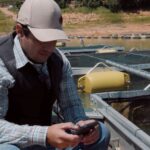


The methodology was tested using Embrapa technologies, such as the Aquicultura Certa app.
Methodology assesses the potential for success of digital technologies in agriculture
Digital agriculture keeps advancing with sensors, drones, and artificial intelligence, promising more accurate decisions. However, those technologies are not always actually adopted. Some, for example, do not address farmers’ most urgent needs or lack digital infrastructure that is not yet fully accessible. Researchers from Embrapa and the University of Campinas (Unicamp) working on the Center for Science for Development in Digital Agriculture (Semear Digital) project have developed a methodology that evaluates digital technologies that are currently under development, aiming to predict whether they have a realistic chance of being successfully adopted in a given agricultural context. The results were published in June 2026 in the journal Smart Agricultural Technology.
“The tool was designed to support decision-making, whether by farmers, developers of agricultural technologies, or investors in the sector. Once they have a feasibility assessment of the technology for that context, farmers and extension workers can evaluate whether it will, in fact, be useful for the farm. Such report can also help in evaluating private or public investments and in the very process of developing those technologies in the laboratory,” explains Luciana Romani, a researcher at Embrapa Digital Agriculture and partnerships coordinator at the Semear Digital center.
The methodology combines the requirements of a technology—whether software or hardware—with the characteristics of the property and its geographic context, the readiness of existing digital infrastructure, the profile of the farmer and their ability to use the proposed technology, and economic viability. “The idea was precisely to address the need to determine whether applying a given digital technology in a specific agricultural context works,” Thais Dibbern, a professor at Unicamp and a researcher affiliated with Semear Digital, asserts.
Stages of the study
The study was conducted in five methodological stages. Firstly, a bibliometric analysis evaluated 814 scientific publications on the adoption of digital technologies, out of which 20 case studies were examined in more depth. Next, the researchers identified ten indices and indicators that are already used by national and international institutions, such as the World Bank’s Agriculture Digitalization Index and Embrapa’s Ambitec-Agro. The mapping aimed both to identify variables relevant to the methodology developed and to demonstrate its originality. “This comparative analysis showed that, until now, there was no methodology that resembled the one we were proposing,” Thais Dibbern says.
Among the features that set it apart from other indices, the tool incorporates variables that are often overlooked in traditional assessments, such as relief, generation of polluting waste, increased water consumption, and even legal issues. “Land ownership, for example, ultimately influences whether or not a farmer chooses to adopt digital technology. It’s not only the cost, it’s not just the ability to understand how it works, but also the trust he places in this type of tool,” the researcher explains.
In addition to those indices and indicators, the researchers also analyzed the literature on barriers to and factors influencing the adoption of technologies in the field. “Based on the barriers and variables of the indicators studied, we developed this new tool to evaluate digital technologies,” Dibbern explains. “After that, we began the validation stage with experts from various fields, followed by a proof of concept using two actual technologies.”
The assessment tool was submitted for validation to 22 agronomy, engineering, computer science, and statistics experts, who helped to assign weights and develop the final assessment scale, which ranges from 1 to 5. “They contributed a great deal to the weight-adjustment process. It was based on that exchange that we developed the formulas and our scale,” the researcher explains.
The proof of concept tested the methodology using two contrasting technologies developed within the Embrapa ecosystem: the Aquicultura Certa software, designed for fish farm management, and a hardware device that, when attached to a harvest bag, automatically counts the number of fruits picked and identifies the most productive trees. The results revealed distinct behavior patterns.
In the case of Aquicultura Certa, the scores differed between the two profiles analyzed. The developers of the technology rated its viability as moderate, giving it a score of 3. As for potential adopters (farmers who were testing the system), the score rose to 4. According to the paper, such discrepancy does not indicate a measurement error, but rather provides a useful insight: by considering the entire range of possible properties—including those with poor connectivity infrastructure—,the developer identifies barriers that the actual user, who is already living in a place with electricity and internet, considers to have been overcome. “Perhaps the developer doesn’t fully grasp the transformation that technology brings about or its impact on the farmer’s life. They never imagined it would have such a big impact in the field, and the results have been very positive,” Thais Dibbern notes.
The fruit-counting hardware, on the other hand, received a score of 4 in both profiles—developer and adopter. Because it requires few infrastructure prerequisites and operates using autonomous Bluetooth-based communication, the technology garnered widespread consensus regarding its high viability. “The results indicate that the proposed model is consistent and reliable for both profiles,” the researchers conclude.
From research to innovation and public policy
Currently, the methodology operates in a spreadsheet, and the goal is to transform it into an app or a widely accessible digital platform. To that end, a second round of validation is planned, since, at the end of the first cycle, the team realized that new issues had arisen that needed to be incorporated and tested—such as the technology’s ease of use and impacts on animal welfare, for example. “We need to conduct a new validation process so that the choice of technologies becomes increasingly precise, to avoid unnecessary costs, and even to help developers gain a clearer understanding of the target audience they want to reach,” Thais Dibbern says.
In addition to direct application in the field, the researchers see potential for the tool to influence the development of technologies at startups and the formulation of public policies. “In the case of startups, it works for a change of course—or a pivot—if you apply the assessment right at the beginning of the idea generation stage,” Luciana Romani explains. “It is especially useful when you don’t have a deep understanding of your audience yet and are in the process of exploring the possibilities to apply the new technology.”
As for public policy, the rationale is that by systematically mapping the barriers to adoption, such as connectivity infrastructure, the need to train, and technical support, the government can target investments more precisely. “Translating the process of adopting technology into public policies, particularly those that relate to government support and funding, while taking those barriers into account, is what catches my attention the most,” Thais Dibbern concludes.
The full paper was authored by Thais Dibbern, Luciana Alvim Santos Romani, Silvio Roberto Medeiros Evangelista, Vagner Azarias Martins, Silvia Maria Fonseca Silveira Massruhá: Diagnostic framework for assessing Smart Agricultural Technology adoption. Smart Agricultural Technology, Volume 14, 2026, 102359, ISSN 2772-3755. Access: https://doi.org/10.1016/j.atech.2026.102359.
| About Semear Digital
Semear Digital is one of the Science Centers for Development (CCDs) supported by the São Paulo Research Foundation (Fapesp). Launched in April 2023 and based at Embrapa Digital Agriculture in Campinas, São Paulo, the project aims to expand access to digital technologies on smallholdings and medium-sized farms. In addition to Embrapa, the institutions associated with Semear Digital include the University of São Paulo Luiz de Queiroz School of Agriculture (Esalq/USP), the Telecommunications Research and Development Center (CPQD), the Campinas Agronomic Institute (IAC/SP), the São Paulo Institute of Agricultural Economics (IEA/SP), the National Telecommunications Institute (Inatel), and the Federal University of Lavras (Ufla), among other partners. |
Érica Speglich (MTb 0100674/SP)
Semear Digital Center
Graziella Galinari (MTb 3863/PR)
Embrapa Digital Agriculture
Press inquiries: Press inquires: agricultura-digital.imprensa@embrapa.br
This text was translated with the assistance of artificial intelligence (DeepL and DeepSeek) and reviewed by Érica Speglich
Translation: Maria Rita Andreozzi, supervised by Mariana de Lima Medeiros (13044/DF)
Embrapa’s press office
Further information on the topic
Citizen Attention Service (SAC)
www.embrapa.br/contact-us/sac/