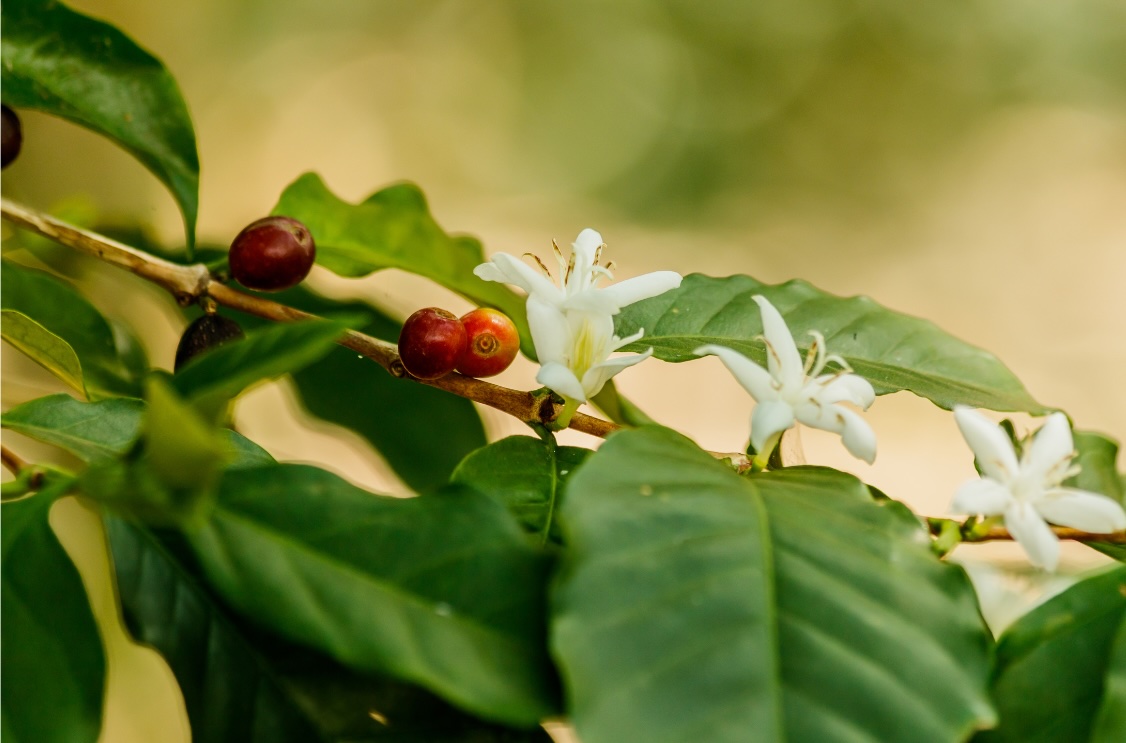
23 de September de 2026
Study evaluates the impact of climate on coffee productivity and validates a model for crop forecasting
The research analyzed 14 years of data from the Poços de Caldas region and may help develop strategies to increase production resilience to climate variability
Coffee production is strongly influenced by climate, particularly temperature and water availability. In the volcanic region of Poços de Caldas in Minas Gerais, a traditional area for growing Arabica coffee, researchers investigated how climate variations affect the productivity of three cultivars at different stages of development. As part of the Semear Digital Project, the study analyzed data from 2011 to 2024 and validated a model to estimate crop yield based on weather information. This information can support decision-making, price forecasting, policy formulation, and strategic planning for coffee producers.
"I am both a researcher and a coffee producer," explains Marcus Vinicius Oliveira Noronha (ESALQ), one of the study's authors. "During my master's program, I was faced with the question of how to research coffee yield without detailed data." The solution came from conversations with other researchers and coffee producers, as well as from combining two sources of information: public IBGE productivity data for the region and detailed production records from a farm in Caconde, São Paulo, which has recorded production since 2011. The researchers also used data from automatic weather stations near the study area covering a 16-year period from 2009 to 2024. This broader time frame was necessary to include the climate conditions of the two years preceding each harvest since this is the length of the coffee's complete cycle.
The scientists divided the coffee tree life cycle into four phases: vegetative growth and leaf bud formation; induction and maturation of flower buds; flowering and fruit expansion; and grain filling. For each phase, they calculated correlations between productivity and variables such as maximum, average, and minimum temperature; relative humidity; precipitation; wind speed; and thermal sum, which is the accumulation of heat over time. Additionally, the team sought to detect climate change trends over the years to determine if temperatures were rising or falling in specific months and how this could affect the different stages of plant development.
"The results showed that the plant is more sensitive and susceptible to temperature variations during the grain-filling phase," explains Noronha. "When maximum temperatures exceed certain levels during this period, productivity tends to fall more sharply than in other phases." However, the greatest climate changes occurred during the flowering period, between August and October.
"The climate is harming coffee flowering more during the transition from winter to spring when the plant is already experiencing water and thermal stress. With rising temperatures, the evaporation of water from the soil and leaves intensifies, worsening the stress,” the researcher emphasizes. The direct result is the loss of flower buds, which compromises production even before the fruits form. “This results in a significant loss in productivity,” says Noronha.
Practical use of the model
The validation of the agrometeorological model yielded significant results for the practical application of the tool. At the regional scale, the model performed well and could accurately estimate productivity. At the local scale, however, performance was more limited. "The explanation lies in the variability of the data, which is very large at the local scale," Noronha explains. "So our model has better predictability at the regional scale, where it can indicate paths for producers."
Currently, access to the model is through a spreadsheet that allows users to enter the property’s productivity data and weather information for a given period. The spreadsheet automatically calculates expected productivity, which can be used by coffee producers for decision-making, price forecasting, policy formulation, and strategic planning.
The team is now developing a fertilization model that considers climate variability. They plan to use productivity, growth, and climate data collected since 2016 in the Southeast and Alta Mogiana regions to guide nitrogen and potassium application. "If the model indicates low productivity due to a water deficit or high temperature, you can make fertilization-related decisions that save resources," says the researcher by way of example. According to Noronha, the next step is to automate the process and transform it into an accessible application for coffee producers.
The full article can be accessed at: O artigo completo pode ser acessado em: Noronha, M. V. O., Silva, J. P., Plachi, M. A., Santana, D. M., Umburanas, R. C., Favarin, J. L., Romani, L. A. S., Massruhá, S. M. F. S., & Dourado Neto, D. (2026). Thermal sensitivity and yield of Arabica coffee under climatic variability. Agronomy Journal, 118, e70458. https://doi.org/10.1002/agj2.70458
Érica Speglich (MTb 0100674/SP)
Graziella Galinari (MTb 3863/PR)
Embrapa Digital Agriculture
Press inquires: agricultura-digital.imprensa@embrapa.br
This text was translated with the assistance of artificial intelligence (DeepL and DeepSeek) and reviewed by Érica Speglich