
Drones and artificial intelligence indicate the best time to slaughter cattle
A system that combines drones and artificial intelligence to monitor feedlot cattle can help raisers to identify the ideal moment to sell or slaughter the animals, reducing costs and increasing yield efficiency. The technology was introduced in a recent paper published by researchers of the Semear Digital project in the scientific journal Computers and Electronics in Agriculture. artigo recentemente publicado por pesquisadores do Science Center for Development in Digital Agriculture (CCD-AD/Semear) na revista científica Computers and Electronics in Agriculture.
Based at Embrapa Digital Agriculture, in Campinas, São Paulo, Semear Digital is one of São Paulo State Research Foundation's (Fapesp) Centers of Science for Development (CCDs). Agriculture Development, em Campinas, o Semear Digital é um dos Centros de Ciência para o Desenvolvimento (CCDs) da FAPESP.
"Traditional weighting methods require labour-intensive handling and can cause stress to the animals, negatively affecting their well-being and weight gain," Everton Tetila, a post-doctoral researcher at Semear Digital and professor at the Federal University of Grande Dourados, explains. “In addition, weighing with scales can lead to frequent damages to the equipment,” Jayme Barbedo, a researcher at Embrapa Digital Agriculture, adds.
The study's aim was to reduce stress caused by weighing and to identify the ideal moment to slaughter, which is when the animal reaches its peak weight gain and starts to convert food into weight increasingly less efficiently.
Turning point
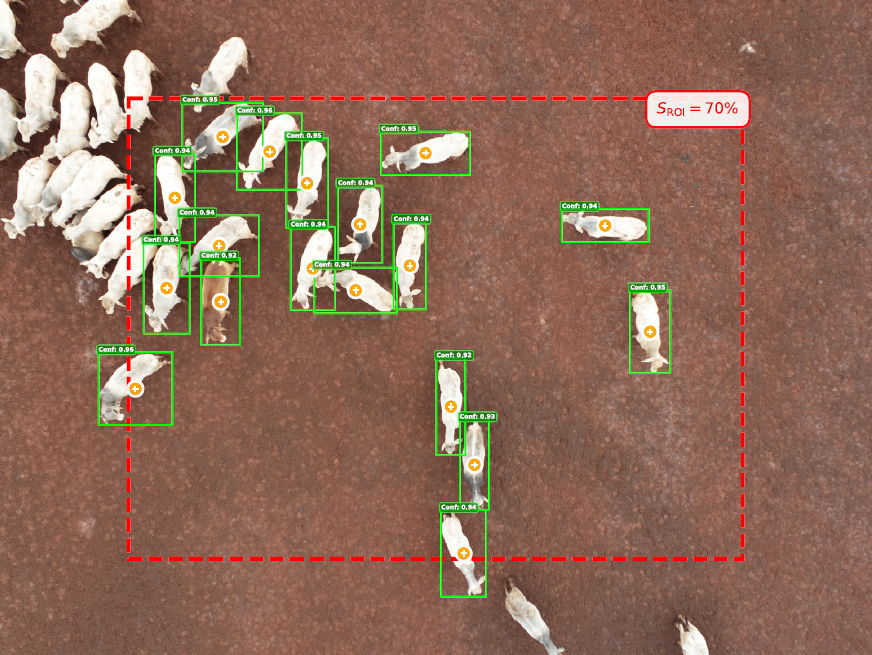
The system was tested in a feedlot in Mato Grosso do Sul, Brazil, where the researchers assessed a herd of cattle throughout 112 days. During that period, regular drone flights were conducted at an altitude of about 15 meters to capture images of the animals.
From those images, researchers from Embrapa Digital Agriculture, the University of São Paulo (USP) and the Federal University of Grande Dourados (UFGD) developed artificial intelligence models that identify the cattle, automatically crop and segment their bodies, and extract body measurements such as length and width. Based on the data, researchers monitored the growth of the herd throughout the time. “We conducted regular flights from the time the cattle entered the feedlot until the final stage of their rearing. The idea was to create a model of the relationship between body measurements and weight gain, taking into account nonlinear variations throughout the production cycle," Tetila explained.
One of the main results was the identification of a typical growth pattern. “The animal gains little weight at first during its adaptation stage, then enters a phase of fast weight gain, and finally, the rate of weight gain slows down,” Tetila said. The turning point corresponds to the moment of maximum weight gain, after which growth starts to slow down. That would indicate the most economically advantageous time to sell or slaughter.
Accurately identifying such turning point can generate significant gains for the farmer, especially in large-scale herds. “In a large group, a difference of just one day can have a significant impact on management costs, especially feed costs, and directly influence the system’s production efficiency and profitability,” the postdoctoral researcher said.
Potential applications
The study also paves the way for other applications. The same database is already being used to develop models that can identify animals’ feeding behavior and detect anomalies, such as bovine sodomy or mounting, which are often associated with stress or improper management practices in feedlot systems.
For Tetila, the next step is to expand the system to other breeds and validate its application on a commercial scale. "We plan to adapt the model to other breeds beyond Nelore, such as Angus and Brahman, and move forward with validating its direct application in feedlots," the researcher said.
The expectation is that this type of solution contributes to precision livestock farming, increasing production efficiency and reducing costs. "If you can identify the ideal slaughter moment, it is possible to reduce production costs and even contribute to reducing beef costs," Tetila says.
Despite the promising results, the researchers emphasize that the technology is still in an advanced development stage. “We’re close to having a working prototype, but we still need a partner to turn it into a commercial product”, Barbedo concludes.
Paula Drummond
Graziella Galinari (MTb 3863/PR)
Embrapa Digital Agriculture
Press inquires: agricultura-digital.imprensa@embrapa.br
Translation: Maria Rita Andreozzi, supervised by Mariana Medeiros (13044/DF) Embrapa's press office